


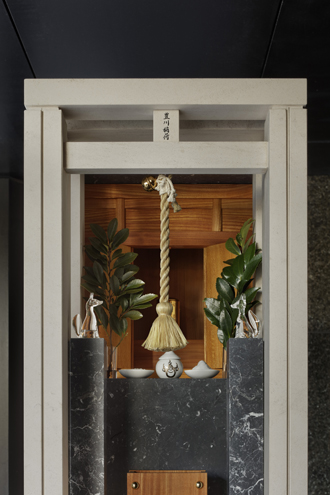
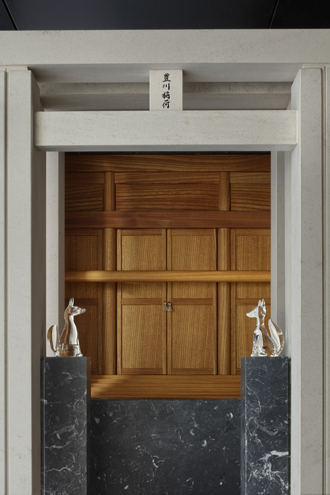
We designed a shrine for Inari kami (Inari kami, with the fox as its servant and messenger, is the god of fertility, agriculture, prosperity and success and is generally considered to be a Shinto spirit).
The project came about as a tiny shrine of Toyokawa Inari in Yaesu had to be relocated to an office building in Kojimachi. As the building housed tenants of many multinational companies, the owner’s request was “to make it as inconspicuous as possible as there are people of different faiths working in the building.” The final structure looks like a simple stone monument from the entrance of the building and only becomes recognizable as a shrine as you go around to its side.
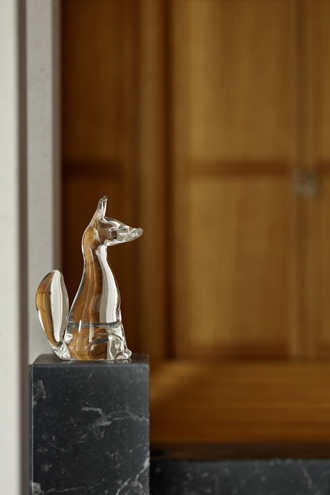
A shocking revelation that Toyokawa Inari was not a Shinto shrine but a Buddhist temple(in Japan, distinction between Shinto spirit and Buddha is sometimes blurred) caused a rethink of how to sort basic designs but we picked what we considered fundamental and combined them during the designing process: we did not pay too much attention to the structure of the torii gate as it is not an essential part of the Buddhist architecture; “the white fox”, which was a servant and messenger of the Inari kami, was an invisible being so we chose glass as its material. For the inner sanctuary, we used the Tokyo branch of Toyokawa Inari as a motif and added a folk art feel at the request of the building’s owner. It may look eccentric at a first glance but the whole designing process was based on very traditional technique.
The project came about as a tiny shrine of Toyokawa Inari in Yaesu had to be relocated to an office building in Kojimachi. As the building housed tenants of many multinational companies, the owner’s request was “to make it as inconspicuous as possible as there are people of different faiths working in the building.” The final structure looks like a simple stone monument from the entrance of the building and only becomes recognizable as a shrine as you go around to its side.
A shocking revelation that Toyokawa Inari was not a Shinto shrine but a Buddhist temple(in Japan, distinction between Shinto spirit and Buddha is sometimes blurred) caused a rethink of how to sort basic designs but we picked what we considered fundamental and combined them during the designing process: we did not pay too much attention to the structure of the torii gate as it is not an essential part of the Buddhist architecture; “the white fox”, which was a servant and messenger of the Inari kami, was an invisible being so we chose glass as its material. For the inner sanctuary, we used the Tokyo branch of Toyokawa Inari as a motif and added a folk art feel at the request of the building’s owner. It may look eccentric at a first glance but the whole designing process was based on very traditional technique.
